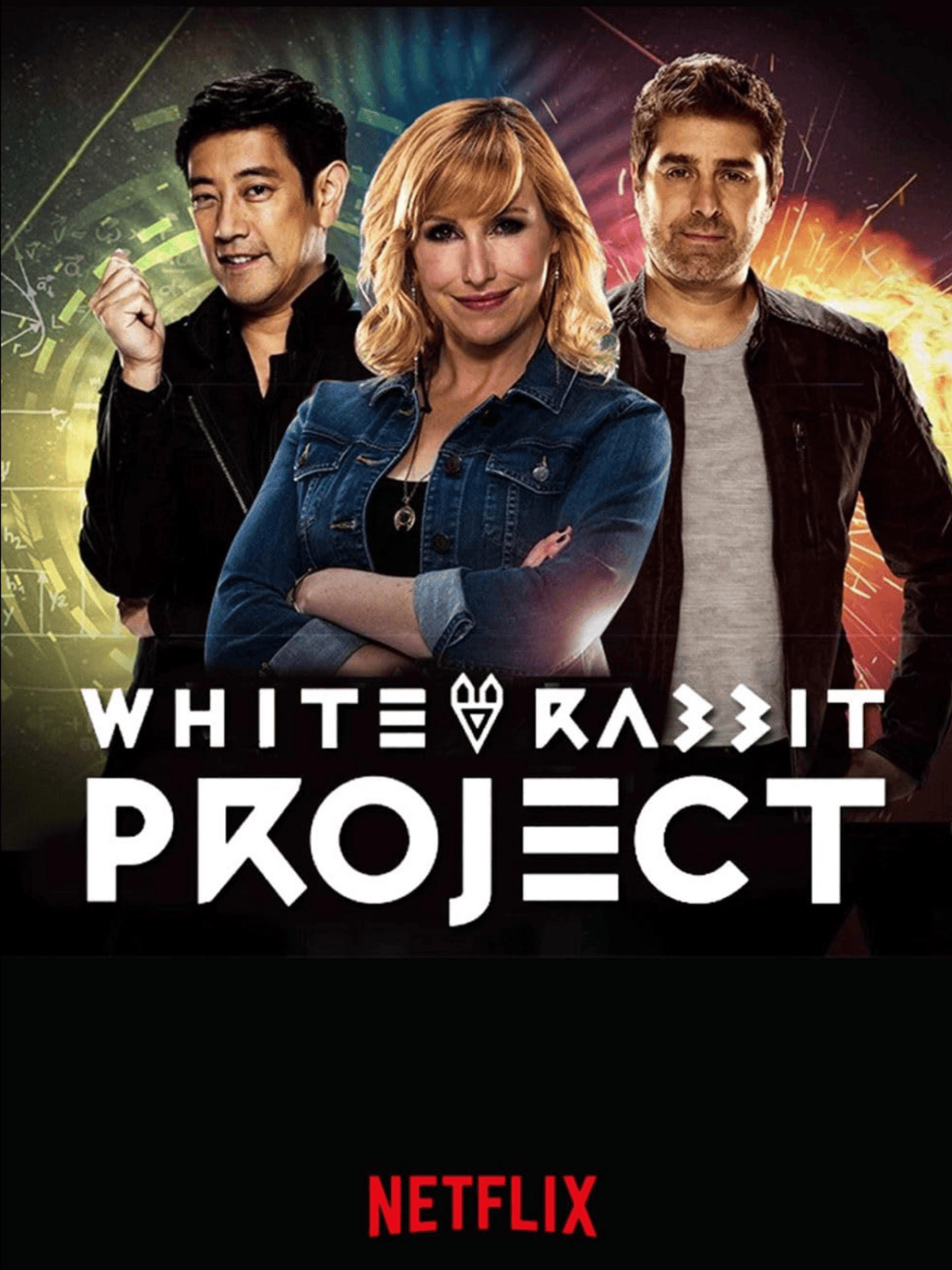
The first Netflix production we ever worked on did not involve establishing shots over a dramatic landscape or sweeping aerial moves across a major set. It involved flying a drone through hoops in a dark studio while a pigeon clicked a button on screen, and later, coordinating in live airspace with a jetpack.
The production was The White Rabbit Project, a Netflix original series built around the creative team behind the original MythBusters. The show’s format involved engineering-based experiments and challenges, frequently at scale, often in conditions that required specific technical problem-solving from every department on set. For the aerial unit, that meant two situations we had not encountered in exactly that form before.
Flying Through Hoops in a Dark Studio
The first sequence required a drone to navigate through a series of hoops inside a controlled studio environment, dark, low-ceiling, the kind of space where margin for error is compressed and where the standard visual reference points an outdoor pilot relies on are absent.
The editorial concept was to simulate an on-screen game mechanic. A pigeon in the sequence responded to visual cues to navigate through the hoops. The drone needed to replicate that flight path for the camera, smooth, controlled, hitting specific marks in sequence, in a space that was deliberately lit for atmosphere rather than for piloting visibility.
Studio drone work at this level requires a different piloting mode than exterior cinematography. You are flying on instruments and spatial memory, reading the environment through the aircraft’s camera feed and your knowledge of where every obstacle is, rather than on visual line of sight in an open environment. The tolerances are tighter. A drift of two feet that would be invisible outside becomes a collision inside. The sequence required multiple passes until the flight path was consistent and clean enough for the editorial cut.
Two Unmanned Aircraft in the Same Airspace
The second situation was more unusual: coordinating with a jetpack in active airspace.
A jetpack is an unmanned or semi-unmanned aircraft system depending on the configuration, and its operation is regulated by the FAA under rules that, at the time, overlapped with the drone regulatory framework in ways that were genuinely novel. We had two FAA-regulated unmanned systems operating in the same airspace, the drone for aerial coverage of the jetpack sequence, and the jetpack itself, and the safety and coordination requirements for that scenario had to be worked out in advance.
The pre-production on that sequence involved determining altitude separation, defining flight paths that would not intersect, establishing communication protocols between the drone crew and the jetpack operator, and confirming with the FAA that the operation was structured to meet compliance requirements. The production’s aerial insurance coverage had to account for both systems.
On the day, the coordination worked. The footage worked. The sequence that made it to screen showed the aerial coverage and the jetpack in the same frame, which was the editorial goal, without incident.
What This Production Did for Us
The White Rabbit Project was not the largest production we had worked on at the time, but it was the most technically varied. The studio interior sequence, the jetpack coordination, the range of engineering content the show required. It pushed us into problem-solving modes that built on the DoD background and the years of aviation experience we brought to the work, and it did so in a format that was specifically about showing what was technically possible.
It was also our introduction to the Netflix ecosystem. The production standards, the documentation requirements, the expectations around compliance and professional conduct on set. Working on a Netflix original, even at the earlier end of the company’s content expansion, meant operating at a level that set a baseline for everything that followed.
What Unusual Production Requests Look Like in Practice
We have worked on a lot of productions since The White Rabbit Project. The range of what gets asked of a drone unit on a professional set is wider than most people outside the industry expect.
We have been asked to fly through a controlled interior space for a performance sequence. We have coordinated with other aircraft in live airspace. We have built and flown a custom-rigged drone carrying a basketball hoop across Los Angeles for a branded content shoot. We have constructed an aerial lighting platform using a remotely controlled light array and a gimbal stabilizer to create a lighting effect for a music video that could not have been achieved any other way.
The common thread is preparation. A production comes to us with a brief that is sometimes conventional and sometimes genuinely unusual. Our job in either case is to get to shoot day having resolved every technical and compliance question in advance, so the shoot itself is about getting the footage, not about figuring out whether the footage is possible.
If your production has an aerial requirement that is outside the standard shot list, book a consultation. The unusual requests are often the most interesting ones.
Have an aerial requirement that is outside the standard shot list?
Unusual production briefs are what we prepare for. Call us to discuss what you are trying to achieve. We will tell you directly whether we can execute it.
Or fill out the contact form. We respond the same day.