September 24, 2026 ·11 min read
By Jaron Denson, owner and aerial director of photography at Drone Tech Aerial. FAA Part 107 remote pilot, flying productions in Los Angeles since 2012.
Dodger Stadium Drone Waiver: How We Got Cleared to Fly in the TFR
A location scout picks Dodger Stadium, or a rooftop in Chinatown, or a street in Echo Park, and the shoot date lands on a game day. The first call to a drone operator ends the same way every time: not on a game day. A producer searching for a Dodger Stadium drone waiver is usually asking a simpler question, which is whether it can be done at all.
It can. In September 2025 we obtained the approvals to fly Dodger Stadium on September 30 and October 1, the two nights the Dodgers hosted the Cincinnati Reds in the National League Wild Card Series, with flight windows planned from noon to midnight on both days. The stadium TFR was active for both games. The venue’s written consent came first, and relief from the TFR came from the FAA on the strength of it. The client cancelled the job before the first flight day, so the flights never happened. The approvals were already in hand, and how they were obtained is the part a producer can use. This is the paperwork side of that job, written for producers, coordinators, and brand teams who need aerials at a stadium and have been told no.
A stadium TFR is a federal closure, and LAANC cannot open it
The rule comes from the FAA, not from the ballpark. Under FDC NOTAM 0/0367, the current issue of the stadium NOTAM (earlier issues carried other numbers, 4/3621 among them), a Temporary Flight Restriction takes effect over any stadium seating 30,000 or more during any regular season or postseason event of Major League Baseball, the NFL, and NCAA Division I football, and NASCAR Sprint Cup, IndyCar, and Champ Series races. It covers a three nautical mile radius up to 3,000 feet above ground level, from one hour before the event until one hour after it ends, and it applies to drones exactly as it applies to helicopters. LAANC does not grant authorizations inside a stadium TFR. A standing Part 107 airspace waiver does not reach into it either. FilmLA’s drone guidance names Dodger Stadium, the Coliseum, SoFi Stadium, and the Rose Bowl for this reason: FAA regulations prohibit all aerial activity, drones included, within three miles of those venues during MLB, NFL, and NCAA games.
Three nautical miles is a large circle. A Dodgers home game closes the air over Echo Park, Chinatown, Elysian Park, and a section of downtown for the length of the game plus two hours. Our guide to Temporary Flight Restrictions in Los Angeles covers how productions schedule around that circle. This post is about the case where scheduling around it is not an option, because the game is the point of the shoot.
That circle is the more common problem, and it has a shorter answer. Most productions near Dodger Stadium are not at the stadium; they are on a rooftop in Chinatown or a street in Echo Park, inside the three miles, with a shoot that has nothing to do with the game. The venue has no reason to consent to that flight, and without the venue’s consent there is no relief to ask for. If your location is inside the circle and you are not the venue’s guest, do not plan on flying on a game day. Move the aerial day. Check the Dodgers’ home schedule against your dates before the location is locked, and look again in September, because postseason dates are set only days ahead.
Relief comes from the FAA, and it does not move without the venue
It does not go through LAANC, and it does not go through the FAA’s emergency waiver form either. When our request went to the FAA’s System Operations Support Center, the answer came back within ten minutes: waivers into a sporting event TFR are applied for on the FAA’s airspace waiver site, where the Transportation Security Administration vets the request and the FAA then reviews and approves it, checking the queue through the day. The operator files it, because the operator holds the certificate and answers for the flight. The request has nothing to stand on without the venue. In Jaron’s words: “To get relief from the TFR, we need to have something from Dodger Stadium that says we’re allowed to be there. Not an easy go, but I got it.”
Ours carried a letter from the Los Angeles Dodgers, signed by the club’s stadium operations office on September 29, 2025, the day before the first planned flight. It confirmed the Dodgers’ consent to our request to fly Dodger Stadium on September 30 and October 1, “operating in support of the Dodgers with the filming of new videos and photos,” and it noted that the FAA would receive a copy. That sentence is the hinge. The venue is telling the FAA that the flight serves the event, and the FAA is deciding whether the operation as planned belongs inside a restriction that exists to keep aircraft away from a crowd.
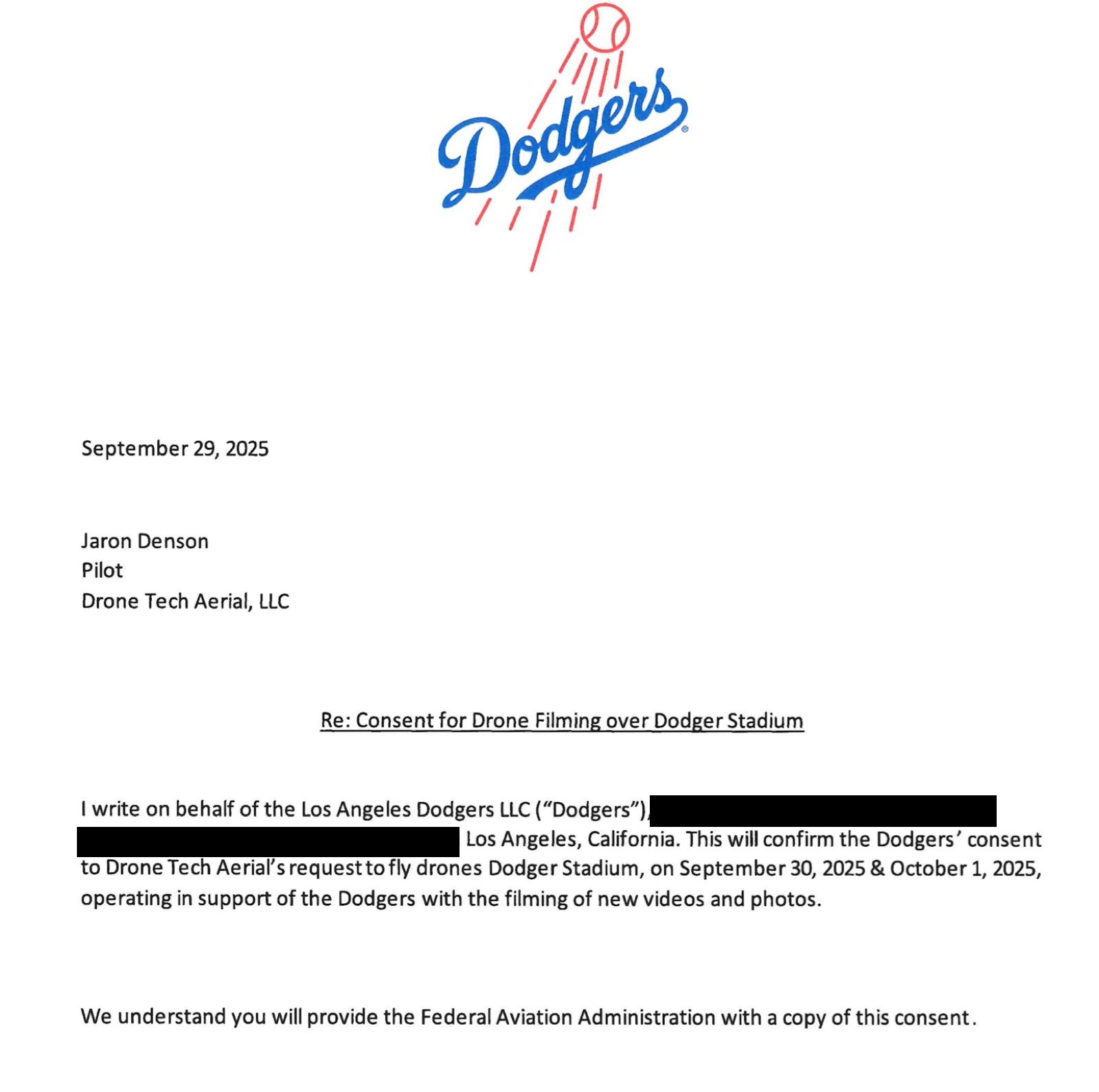
The Dodgers’ written consent, dated the day before the first planned flight. Signature, name, and title removed.
Here is how fast it moved, because the timing surprised us and it should not be taken as typical. The Dodgers’ letter reached us at 11:33 on the morning of September 29. Our request went to the FAA at 1:14 p.m. with the letter and our credentials attached. The redirect to the waiver site came at 1:23 p.m. The FAA’s approval arrived at 3:20 p.m.: a two-page letter headed Authorization Number 2025-SPTUAS-192853, which the FAA itself calls a security airspace waiver. It answers our “request for relief of the temporary flight restrictions detailed in FDC NOTAM 0/0367,” names both pilots and both aircraft, authorizes the operation inside the named sporting event TFR “for the purpose of venue operations survey,” and is effective on the two listed dates only. It is explicit about what it is not: a security authorization to enter the restricted airspace, not relief from any other rule, permit, or Part 107 requirement, and a copy sits on file with the Transportation Security Administration’s airspace authorizations office. By 4:36 p.m. the Los Angeles Fire Department had sent its own list for flying at the stadium: each pilot’s certificate, a plot plan with launch points and a safety zone, insurance, the FAA waiver, the aircraft list, the schedule, a special LAFD permit for drones in the city, and a fire safety officer on site an hour before the first takeoff until the last landing, with a second officer if the two aircraft flew out of one officer’s line of sight.
The waiver was granted, and it is hard to get. There is no formula to publish. There is a case, made in writing, with the venue’s name on it, a plan of activities the FAA can read, and an operator whose paperwork and record hold up. What we can show is what the plan contained.
What the plan covered: two playoff nights, noon to midnight, on two small aircraft
The plan of activities filed for the job describes it plainly: filming of traffic patterns at Dodger Stadium, on September 30 and October 1, 2025, with flight windows from 12:00 to 23:59 each day. First pitch both nights was 6:08 p.m., so the windows covered the hours before the gates opened, the arrival, the game, and the exit. A data-analytics client had hired us to capture how traffic moved through the stadium’s lots on a postseason night, for a traffic-pattern analysis, and the aerial view is the only one that shows the whole system at once.
Two pilots were named: Jaron Denson as chief pilot and Randall Berkeley, both FAA Part 107 certificated. The aircraft were a DJI Mavic 2 and a DJI Mavic 3, about four pounds per the plan, with flights averaging 30 minutes and a ceiling of 400 feet. Launch and recovery were planned from areas closed to the public, and the plan noted that a pad as small as six feet by six feet would do, which matters at a venue where every open square of asphalt fills with cars.
Then the client cancelled the job, and the reason deserves a producer’s attention. Flying a drone in the City of Los Angeles takes a special permit from the fire department, and the fire department requires a fire safety officer on site from an hour before the first takeoff until the last landing, with a second officer the moment two aircraft fly beyond one officer’s line of sight. Two aircraft across two noon-to-midnight windows meant two officers, billed by the hour, for a long time. It was a cost the client had not planned for, and they chose not to proceed. The cancellation came after the venue’s consent and the FAA’s relief were in place, and neither depended on the client: the consent was to Drone Tech Aerial’s request, and the relief was for the operation as planned. The lesson for a producer is the order of operations and the budget line, not the outcome.
Why the plan called for four-pound aircraft
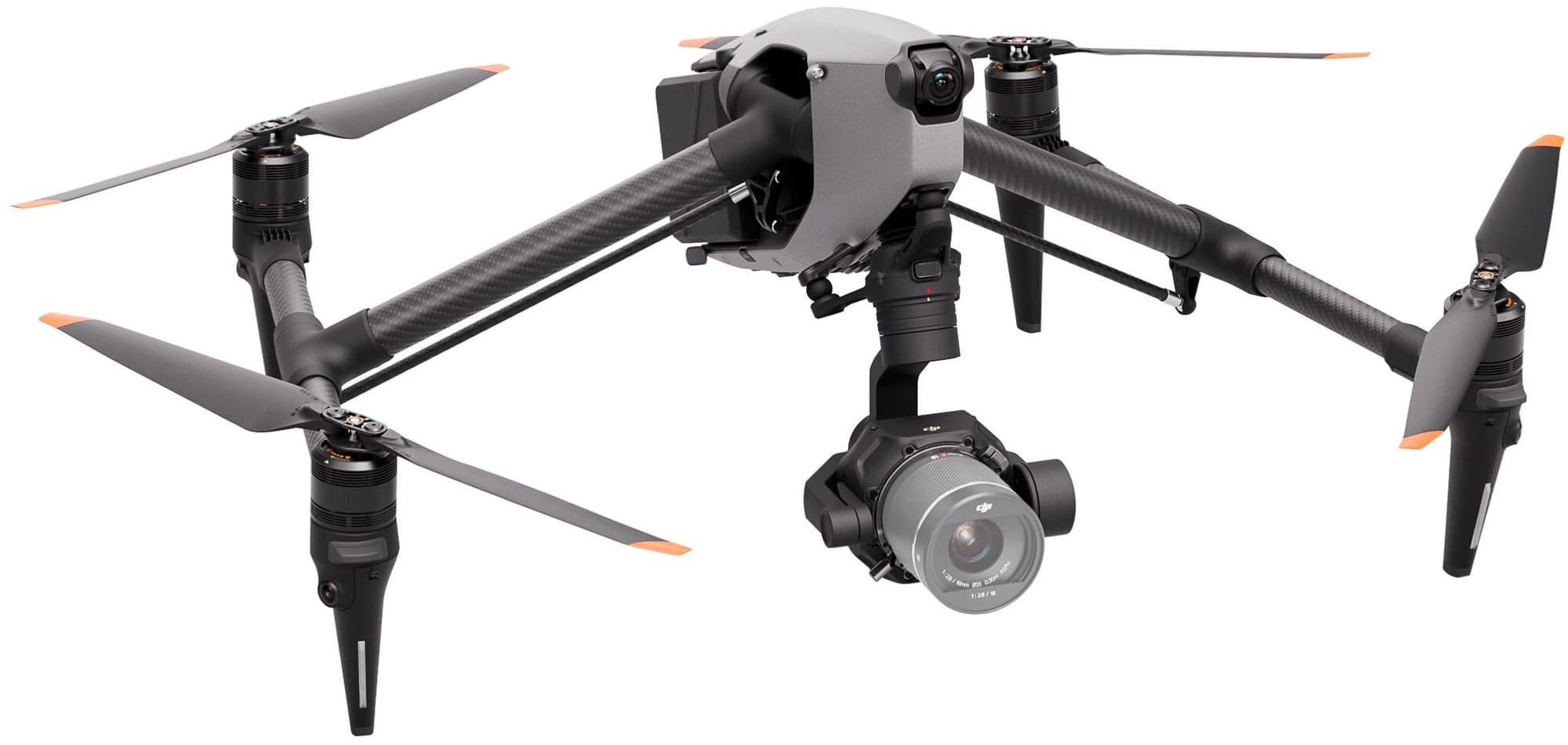
Our cinema work flies on the DJI Inspire 3 and the Freefly Alta 8. Neither was on the plan for Dodger Stadium, for two reasons. The first is written in the plan: a small aircraft, about four pounds, for increased safety to personnel. The deliverable was data, not a hero shot, and a four-pound aircraft over a parking lot full of arriving fans is a different conversation with a regulator than a heavy-lift platform carrying a cinema camera. The second is endurance. The job was to watch traffic build and dissipate around a game, which means long, uneventful flights rather than short cinematic ones, and the Mavic series stays up a long time on a battery. We choose the aircraft at the nexus of safety and image quality, or whatever the producer and director want. It is a la carte, and the plan of activities is where the choice is written down and justified.
What a producer should do first
- Pull the stadium’s schedule before you lock a date. The TFR follows the event, and the FAA’s SEAMS website lists every covered event with its location and its start and end times, usually for the whole season. If the shoot does not need the game, schedule the aerial work outside the window; one hour after the last out, the airspace reopens. If your location is inside the three miles but not at the venue, this is the whole answer: there is no consent to ask for, so move the aerial day. If the shoot needs the game and the venue, everything below applies.
- Start with the venue. A stadium TFR request without the venue’s written consent has nothing behind it. The letter should say who is flying, on which dates, and that the flights support the event.
- Build the calendar around the FAA, not the call sheet. The request is decided case by case. Ours was approved in an afternoon, and we would not plan on that; start the moment the venue will sign.
- File a plan the FAA can read. Aircraft and weights, pilots and certificates, dates and windows, altitude ceiling, flight durations, and launch and recovery areas that keep the public out. Our guide to the plan of activities covers the document.
- Budget the fire safety officers. Drone work in the City of Los Angeles carries a fire department special permit and a fire safety officer on site from an hour before the first takeoff to the last landing, and a second officer once two aircraft fly beyond one officer’s line of sight. It ended this job.
- Keep the city permit in view. For permitted filming inside Los Angeles, FilmLA requires proof of FAA airspace authorization for restricted airspace, a $2M aviation certificate and endorsement page naming FilmLA and its entities, and drone paperwork by noon on the date the permit application is due.
- Expect the venue and the city on the certificate of insurance. Our COI guide for film production covers the endorsements that get asked for.
- Choose the aircraft for the job, and write the reason into the plan.
- Get the approvals before the client’s budget meeting, not after. Ours were in hand when the job was cancelled. Approvals that exist can be used; approvals that were never started cannot be rushed once a date is real.
Questions producers ask
Can you fly a drone at Dodger Stadium?
Not during a game without relief from the FAA. The stadium TFR closes three nautical miles of airspace from one hour before first pitch to one hour after the final out, and it covers drones. Outside that window the normal Part 107 rules for the airspace apply, and the venue still decides what happens over its own property. With the venue’s consent and the FAA’s relief, game-day flights can be permitted; we obtained that clearance for both nights of the 2025 Wild Card Series. If your shoot is near the stadium rather than at it, the venue will not consent to a flight that has nothing to do with its event, so there is nothing to ask the FAA for; plan the aerial day around the schedule instead.
Does LAANC cover a stadium TFR?
No. LAANC authorizes flights in controlled airspace under the standard rules, and a TFR overrides it. A LAANC approval for the grid around Dodger Stadium is valid until the TFR activates, and then it is not.
Is the TFR active on days without a game?
No. The stadium TFR under FDC NOTAM 0/0367 is tied to the listed sporting events. Other large events can carry restrictions of their own, so check the FAA’s TFR list for the specific date rather than assuming.
Who applies for the waiver, the production or the operator?
The operator files the request, because the operator holds the Part 107 certificate and answers for the flight. The venue supplies the consent. The production’s job is the introduction and the timeline: get the venue’s stadium operations office on board early, and get the operator the dates, windows, and purpose of the flights so the plan of activities matches what the venue signed.
Where to go from here
The stadium case is the rarest chapter of our Los Angeles drone filming permit guide, which covers the whole approval stack for ordinary days as well.
Our airspace waivers page lists the standing Part 107 waivers we hold for the Los Angeles airports and for night operations. The guide to drone TFRs in Los Angeles covers wildfire, VIP, and stadium restrictions and how productions schedule around them. If your shoot needs a stadium on a game day, send the venue, the dates, and what the aerials are for, and we will tell you what the request needs and whether the calendar can hold it: book a consultation.