Los Angeles Drone Filming Permit Guide
Every approval an aerial unit needs before it flies on a Los Angeles production, on one page, written by the operator who files them. Request a Quote
Watch Reel
- Operating since 2012
- FAA Part 107 certified
- Active night waiver
- Netflix approved vendor
The short version
A drone on a Los Angeles shoot needs two separate permissions from two separate governments. The FAA owns the sky and decides whether the aircraft may be there. The city, county, or state agency that owns the ground decides whether the production may launch, land, and film from it. Neither one covers the other. A LAANC authorization does not get you onto a county beach, and a FilmLA permit does not open Class B airspace.
In practice the stack for a typical permitted day looks like this:
- A current FAA Part 107 remote pilot certificate for every pilot who will fly.
- FAA airspace authorization for the location: LAANC for most of the basin, a manual request where the grid ceiling is too low, a security airspace waiver inside a stadium TFR.
- Any waiver the operation needs beyond standard Part 107: night, flight over people with a cinema aircraft, beyond-ceiling altitudes.
- The film permit for the ground, with the drone named on it: FilmLA for the City and County and its contract cities, or the separate offices in Malibu and Santa Monica, or the state for parks, beaches, and highways.
- The permit office’s drone rider: questionnaire, pilot certificate, aircraft registration, a written plan of activities with maps, proof of airspace authorization, and aviation insurance certificates naming the permit office and the jurisdiction.
- A fire safety officer where the jurisdiction requires one for drone work, and the Los Angeles Fire Department’s own special permit for drones inside the City.
- A TFR check at scheduling, 72 hours out, and the morning of the shoot, because a restriction overrides everything above it.
Drone Tech Aerial files all seven for every job we fly. The rest of this page explains each one, who issues it, how long it takes, and what to ask any operator for.
Who permits what in Los Angeles
The first question on any Los Angeles drone shoot is not whether the aircraft can fly. It is where the crew will be standing. Takeoff and landing happen on the ground, and the ground is what gets permitted.
| Where the production stands | Who issues the film permit | What that means for the drone |
|---|---|---|
| City of Los Angeles streets, parks, and most private property in the City | FilmLA | The drone goes on the FilmLA permit with its drone rider. LAFD issues its own permit for drone use and assigns a fire safety officer where required. |
| Griffith Park and other City of Los Angeles parks | Los Angeles Recreation and Parks film office, then FilmLA | Reserve the location with the park film office first; FilmLA coordinates fire, police, and the drone rider. |
| Unincorporated Los Angeles County and FilmLA contract cities | FilmLA | Same rider, with the county or the contract city named on the insurance certificates. |
| Los Angeles County beaches: Zuma, Point Dume County Beach, Nicholas Canyon, Will Rogers, Dockweiler, Venice | County Beaches and Harbors, through FilmLA | County policy does not allow drones on its beaches. A county pilot program opened Venice Beach to permitted productions and ran through July 31, 2026; see the Venice chapter below for where that stands. |
| City of Malibu streets, parks, and city property | City of Malibu film permit office | Malibu runs its own program. FilmLA does not cover the city, so a beach day with a company move to a Point Dume street is two permits from two offices. |
| City of Santa Monica, including the pier and Santa Monica State Beach | Film Santa Monica | Since September 1, 2025, Santa Monica permits its own filming. Drone use is reviewed case by case, and the office sets its own aviation insurance requirement. |
| City of Burbank, including locations around the studio lots | City of Burbank film permit office | Burbank asks for a drone addendum with the film application, at least five business days before the shoot, and its municipal code bars flying over or within 50 feet of a studio or closed set without permission. |
| City of Pasadena, including the Rose Bowl area | City of Pasadena Film Office | Pasadena has its own drone application and allows up to five business days to process it once the insurance, plan of activities, and flight notice are in. |
| City of Long Beach, the waterfront, and the port | Long Beach Special Events and Filming, with the Long Beach Fire Department | The fire department issues its own drone permit and asks for the pilot certificate, registration, plan of activities, and an aviation certificate of at least $5 million. The Port of Long Beach runs a separate permit with its own notice to Harbor Patrol. |
| California State Parks and state beaches: Leo Carrillo, El Matador, Malibu Lagoon, Point Mugu, Malibu Creek, Topanga | California Film Commission, on behalf of State Parks | State Parks restricts drones in its units. The permit has to authorize the aircraft specifically, and the calendar is longer than a county beach. |
| Pacific Coast Highway and any state highway, shoulder, or turnout | Caltrans encroachment permit, through the California Film Commission | Flight over a state highway is prohibited without the Caltrans permit. Requests with a drone are reviewed case by case and should go in twelve business days ahead. Traffic control is its own permit through the Highway Patrol. |
| Santa Monica Mountains National Recreation Area | National Park Service | Weeks of lead time and no assurance of approval. |
| Dodger Stadium, SoFi Stadium, the Coliseum, the Rose Bowl on event days | The venue, then the FAA | A stadium TFR is a federal closure. Relief comes only from the FAA, on the strength of the venue’s written consent. See the Dodger Stadium chapter. |
FilmLA does not cover every city a Los Angeles production wants to shoot in. Santa Monica, Burbank, Pasadena, Long Beach, Malibu, and Beverly Hills each run their own film office, and each one has its own drone paperwork, insurance limit, and clock. The office to call is the one that owns the ground under the launch point.
Two things trip productions most often. The first is assuming FilmLA covers Malibu; it covers the county beaches inside Malibu and the unincorporated canyons, and the city handles its own streets. The second is the state beaches between Point Dume and Leo Carrillo, which look like any other cove and belong to State Parks.
The FAA side: airspace, waivers, and restrictions
Part 107. Every pilot flying for compensation holds an FAA remote pilot certificate, kept current with recurrent training. Ask for the certificate number and the name on it. Part 107 by itself does not cover night flight, flight over people with a cinema aircraft, or controlled airspace. Those are separate.
LAANC and controlled airspace. Six airports sit close enough to matter on most Los Angeles locations. LAX is Class B and the most restrictive, with many grid cells near the airport capped at zero. Burbank is Class C and covers the studio lots. Long Beach, Van Nuys, Santa Monica, and Hawthorne are Class D. Inside any of them, the pilot needs an airspace authorization for the specific location, altitude, and window. LAANC grants it in minutes where the planned altitude is under the published ceiling. Above the ceiling, the request goes to the controlling facility for manual review and takes days to weeks. The airport by airport detail is in drone cinematography in restricted LA airspace.
Night. Since 2021, Part 107 allows night flight with anti-collision lighting visible for three statute miles and the updated pilot training. We also hold a formal night waiver and carry the lighting on every night operation. What the waiver adds, and why productions still ask for it, is in night flight waivers for drone production.
Flight over people. Cinema aircraft like the Inspire 3 and the Alta 8 do not fit any of the FAA’s over-people categories, so the shot is designed around non-participants rather than over them. Crew directly participating in the flight, and people under cover or inside stationary vehicles, are excluded from the prohibition. Sustained flight over a crowd with a cinema platform is a 107.39 waiver conversation, planned weeks out. How that works on a set and at a live event is in flying drones over people.
Temporary flight restrictions. A TFR overrides every authorization above. Stadium TFRs switch off a three nautical mile circle around Dodger Stadium, SoFi, the Coliseum, and the Rose Bowl from an hour before an event to an hour after. Wildfire TFRs appear with no notice. VIP movements can close the Westside for an afternoon with a day or two of warning. We check TFRs when the aerial day is scheduled, 72 hours out, and the morning of the shoot. The types, and how to schedule around them, are in drone TFRs in Los Angeles. The one case where relief inside a stadium TFR is possible is documented, with the FAA’s authorization and the venue’s letter, in the Dodger Stadium drone waiver. The February 2027 Super Bowl at SoFi brings a far larger restriction, measured in tens of miles rather than three, for the day of the game.
Remote ID. Every aircraft we fly broadcasts Remote ID. Anyone with a phone app can read the aircraft’s position and the control station’s location from the ground. What that means on a location with a security concern is in Remote ID on film sets.
The FilmLA drone rider
When a drone is on a FilmLA permit, the permit office asks for a specific package on top of the standard application. The list is published on FilmLA’s own drone page, linked in the sources below, and most other Southern California permit offices work from a similar one:
- A completed drone questionnaire.
- The remote pilot certificate for each pilot who will fly.
- The FAA registration for each aircraft, including any backup.
- A written plan of activities with maps: launch and landing points, the flight area, altitudes, dates, and time windows.
- Proof of FAA airspace authorization where the location is in controlled airspace.
- Two aviation liability certificates at $2 million each with their endorsement pages, one naming FilmLA and its entities and one naming the jurisdiction where the flight happens (FilmLA’s sheet says blanket endorsements are not accepted), plus the City of Los Angeles hold harmless agreement when the location is in the City.
- For night work, a pilot certificate or knowledge test dated on or after April 21, 2021, since FilmLA no longer accepts the older night waivers alone.
The deadline is the part that costs productions aerial days. FilmLA’s current drone sheet (revised February 26, 2026) says the drone documentation must be uploaded to MyFilmLA by noon three business days before the first date of filming, and that incomplete documentation is no longer accepted: the drone activity is removed from the permit and the rest of the shoot proceeds without it. Adding a drone to an already approved permit is an amendment, and amendments do not always clear before the shoot day. The drone belongs on the application from the start.
The plan of activities is the document the rest of the package hangs on. It is also what a FilmLA monitor, a police officer, or a studio safety supervisor reads on set to understand the operation in one pass. What a good one contains, and why it needs three business days from a confirmed location, is in what a plan of activities is.
What the paperwork looks like
Most guides describe these documents. This is one of them. In September 2025 we asked the Los Angeles Dodgers for consent to fly at Dodger Stadium inside the stadium restriction, and the FAA issued authorization 2025-SPTUAS-192853 on the strength of this letter.
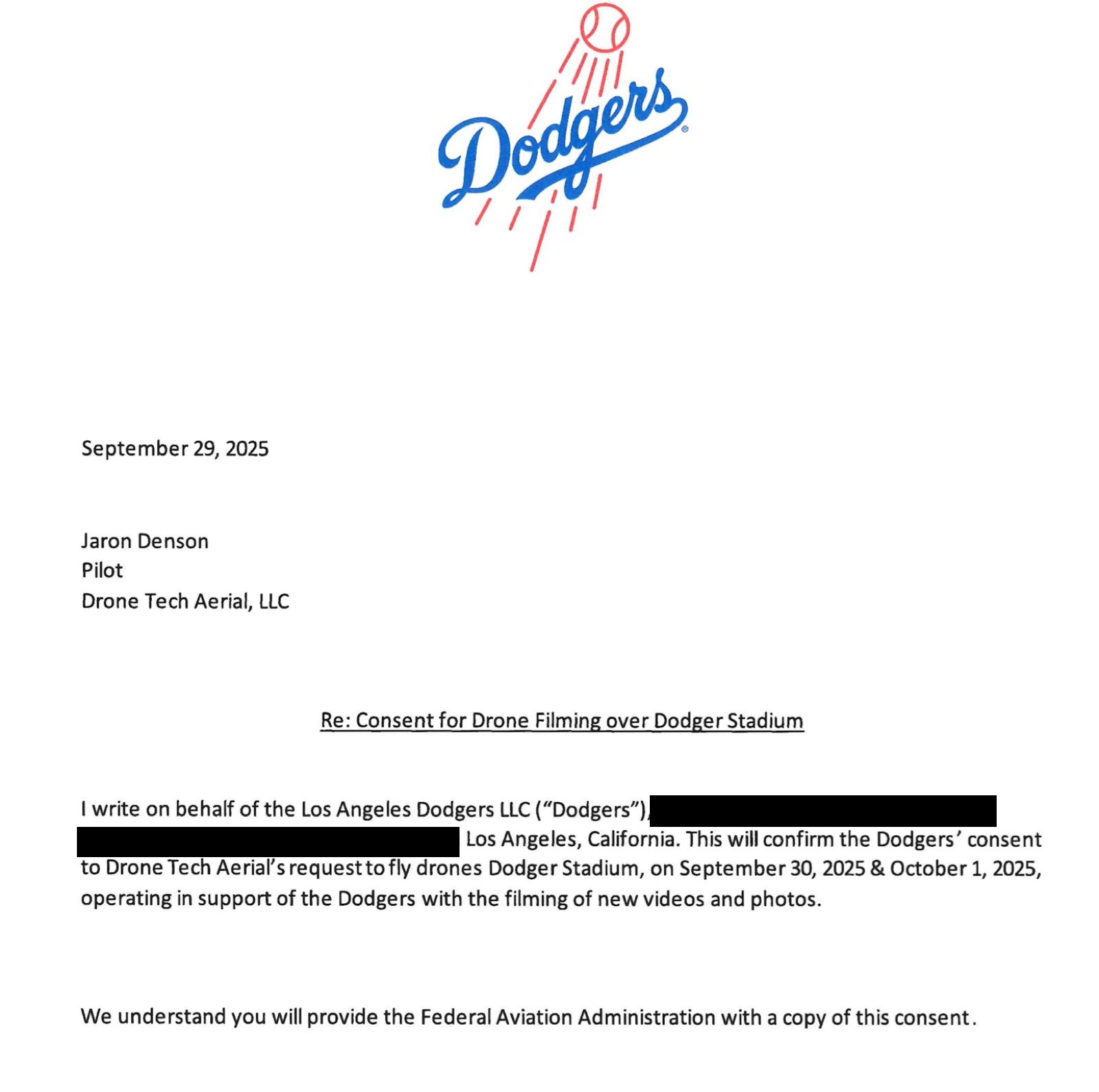
The venue’s letter comes first, the FAA’s relief second, and the fire department’s requirements third. The client cancelled before the first flight day, after every approval was in hand, and the full sequence is in the Dodger Stadium drone waiver.
Insurance and the certificates the permit office reads
Standard commercial general liability commonly excludes aircraft, and a drone is an aircraft. The operator needs its own aviation liability policy, and the certificate of insurance is the document that names the production company, the studio, the location owner, and the public agencies on the permit as additional insureds. Four or five additional insureds on one shoot is normal. We provide $5M aircraft liability per flight for the productions we fly, and issue certificates with the endorsements the production’s risk department specifies.
The permit office reads the certificate against the plan of activities. In 2015 a broker transposed two digits of an aircraft registration on a certificate, and FilmLA would not clear the flight until a corrected certificate was issued over a holiday weekend. Every certificate and drone schedule we send is now read against the plan, digit by digit, before it goes out. That story, and the endorsements a studio will ask for, are in drone insurance for film production.
Fire safety officers and the LAFD drone permit
Inside the City of Los Angeles, drone use on a permitted shoot runs through the Los Angeles Fire Department’s film unit as well as FilmLA. For some operations the department assigns a uniformed fire safety officer for the length of the drone work, on site from before the first takeoff until the last landing, with a second officer if two aircraft fly beyond one officer’s line of sight. The officer is billed to the production by the hour, with a four-hour minimum, prepaid to the department before the permit is released. On the coast and in the canyons during fire season, the officer’s call on a red flag day overrides the shot list. This is the budget line that ends more aerial days than any FAA rule, and it is the reason the Dodger Stadium job in the chapter below was cancelled by the client after every approval was in hand.
Lead times
| Approval | Typical lead time | Notes |
|---|---|---|
| LAANC authorization under the grid ceiling | Minutes | Tied to a specific window; a schedule slip can mean a new request. |
| Manual airspace authorization above the ceiling | 7 days to several weeks | Filed on day one of prep for LAX and Burbank locations. |
| FilmLA permit with drone rider | Days, by the jurisdiction’s application deadline | Drone documentation uploaded to MyFilmLA by noon three business days before the first filming date. |
| City of Malibu | Days to a week or more | Depends on the calendar and the neighborhood. |
| Film Santa Monica | About five business days | Drone use reviewed case by case. |
| City of Burbank with drone addendum | At least five business days | Addendum filed with the film application. |
| City of Pasadena with drone application | Up to five business days | The clock starts when the paperwork is complete. |
| Long Beach with fire department drone permit | Up to seven business days | The port is a separate permit. |
| California State Parks through the Film Commission | Longer, park by park | Aircraft must be named on the permit. |
| Caltrans encroachment permit with a drone | Submit twelve business days ahead | Processing can run seven business days or longer. Lane closures add more. |
| National Park Service | Weeks | No assurance of approval. |
| Night or over-people waiver from the FAA | Weeks to 90 days | Operator specific, planned in prep. |
| Stadium TFR relief | Days, with the venue’s consent first | Not something to schedule a shoot around. |
Our rule of thumb: three business days from a confirmed location to shoot day is the minimum for a plan of activities, an airspace authorization, and the insurance certificates to be written, filed, and approved without a scramble. LAX-adjacent, state, and federal locations need more.
What to ask any operator for
Producers do not need to memorize any of this. Three requests sort the field:
- The compliance package as one PDF. Part 107 certificate for the pilot who will actually fly, the active waivers with their FAA case numbers, a sample LAANC authorization, a sample plan of activities, and a sample certificate of insurance. A working operator produces this in under an hour.
- Who checks TFRs, and when. The answer should name three checks, the last one the morning of the shoot.
- Which offices your location touches. An operator who flies this market regularly will tell you on the scout whether the sand is county or state, whether the street is Malibu or FilmLA, and whether the stadium calendar matters.
The longer vetting conversation is in how to staff an aerial unit for a Los Angeles shoot and the drone producer’s compliance checklist.
The producer’s checklist
A one-page version of this guide for the production office: download the Los Angeles drone permit checklist (PDF).
- Confirm who owns the ground under the launch point, and which film office permits it.
- Put the drone on the film permit application from the start.
- Get the operator’s compliance package as one PDF: pilot certificates, aircraft registrations, waivers, sample plan of activities.
- Send the operator every additional insured the production, studio, location, and permit office need named.
- Confirm the airspace: LAANC, a manual authorization, or a location that needs to move.
- Check the stadium and event calendars before the location is locked.
- Budget the fire safety officer where the jurisdiction requires one.
- Have the plan of activities in hand three business days before the shoot.
- Check temporary flight restrictions at scheduling, 72 hours out, and the morning of.
- Keep the permit, the authorization, and the plan of activities on set, on paper.
What changed recently
- Santa Monica left FilmLA. Since September 1, 2025, Film Santa Monica issues the city’s film permits.
- The Venice Beach drone pilot ended. Los Angeles County’s pilot program for permitted drone filming at Venice ran through July 31, 2026. County beaches otherwise do not allow drones.
- FilmLA wants the 2021 night credential. A pilot certificate or knowledge test dated on or after April 21, 2021 is required for night work. Older night waivers alone are not accepted.
- Drone crews are covered on union shows. Since 2024, drone crews on IATSE Local 600 signatory film and television productions are classified in the camera department. How we work those shows is on our Local 600 productions page.
- The Super Bowl comes to SoFi in February 2027. The flight restriction for that day is far larger than a normal stadium restriction.
We review this page whenever one of these offices changes its rules. The date at the top is the last review.
The chapters
Each of these goes deeper on one part of the stack, with the documents from our own jobs where we have them.
- The drone producer’s compliance checklist: the seven items, what each covers, and what fails when one is missing.
- Drone cinematography in restricted LA airspace: LAX, Burbank, Long Beach, Van Nuys, Santa Monica, and Hawthorne, airport by airport.
- Drone TFRs in Los Angeles: stadium, wildfire, VIP, and special event restrictions, and the three-check schedule.
- The Dodger Stadium drone waiver: the venue’s consent letter, FAA authorization 2025-SPTUAS-192853, and the LAFD list that followed.
- Night flight waivers for drone production: the 2021 rule, the waiver, and what each means on a night call.
- Flying drones over people on film sets and at live events: the categories, the exclusions, and flight geometry.
- What a plan of activities is: the document every permit office reads first.
- Drone insurance for film production: aviation liability, additional insureds, and the certificate that nearly cost a shoot day.
- Drone filming at Venice Beach: the LA County pilot program and what a production had to bring.
- Remote ID on film sets: what the aircraft broadcasts and who can read it.
- Cinema drone wind limits: Santa Ana winds, sea breeze, and when we call the day.
- Our airspace waivers: the wide-area authorizations we hold for the airports around Los Angeles.
Questions producers ask
Do I need a permit to fly a drone for a commercial in Los Angeles?
Yes, two of them. The FAA requires a Part 107 pilot and, in most of the basin, an airspace authorization. The agency that owns the ground requires a film permit with the drone named on it, which is FilmLA for the City and County, or the City of Malibu, Film Santa Monica, the California Film Commission, or the National Park Service depending on where the production stands.
Does FilmLA handle the FAA airspace authorization?
No. FilmLA reviews every drone location for airspace restrictions and asks for proof of FAA authorization where it is needed, but the pilot pulls the authorization through LAANC or the FAA directly. The two approvals are independent and both have to be in hand.
How far ahead do I need to book a drone for a permitted Los Angeles shoot?
Three business days from a confirmed location is the minimum for a plan of activities, an airspace authorization, and the insurance certificates. Locations near LAX, state beaches and parks, Caltrans highways, and anything federal need a week to several weeks, and the drone has to be on the permit application from the start rather than added later.
Can a drone fly near Dodger Stadium or SoFi on a game day?
Inside three nautical miles during the event window, only with the venue’s written consent and a security airspace waiver from the FAA, which is rare and exists for operations that serve the event. For a shoot in Echo Park or Inglewood that has nothing to do with the game, the answer is to move the aerial day. The stadium calendar is checked before the location is locked.
Who pays for the fire safety officer?
The production. Inside the City of Los Angeles the fire department can assign an officer to drone operations for the length of the work, billed by the hour, and some county and city permits on the coast require one as well. It belongs in the aerial budget line before the permit is filed.
Does FilmLA cover Santa Monica, Burbank, Pasadena, or Long Beach?
No. Each of those cities runs its own film office with its own drone paperwork. Santa Monica has issued its own permits since September 1, 2025. Burbank asks for a drone addendum, Pasadena has a drone application, and Long Beach requires a fire department drone permit.
Can a drone fly at a Los Angeles County beach?
County policy does not allow drones on its beaches. A county pilot program for permitted productions at Venice Beach ran through July 31, 2026. State beaches belong to State Parks, which restricts drones and has to authorize the aircraft on the permit.
Does the production’s own insurance cover the drone?
Usually not. General liability policies commonly exclude aircraft. The operator carries aviation liability and issues a certificate naming the production, the studio, the location owner, and the permit agencies as additional insureds.
Sources
Rules and lead times on this page come from the offices that set them. Check the current version with the office before you file.
- FilmLA: Filming with Drones
- California Film Commission: Filming with Drones
- California Film Commission: Caltrans Highways and Freeways
- California State Parks: Drones in State Parks
- Film Santa Monica: FAQ
- City of Burbank: Drone Information Addendum to Film Permit
- City of Pasadena: Request to Use Unmanned Aircraft Systems for Filming
- City of Long Beach: Special Events and Filming
- FAA: Stadiums and Sporting Events
- FAA: LAANC
- FAA: Temporary Flight Restrictions
Ready to Book a Consultation?
Send the locations and dates, and we will tell you which offices each one touches, what the airspace allows, and what the paperwork calendar looks like before the first application goes in. Request a Quote
Written by Jaron Denson, owner and aerial director of photography, FAA Part 107 remote pilot. Last updated October 6, 2026.