July 1, 2026 ·7 min read
By Jaron Denson, owner and aerial director of photography at Drone Tech Aerial. FAA Part 107 remote pilot, flying productions in Los Angeles since 2012.
Drone Cinematography in Restricted LA Airspace: LAX, BUR, LGB, and VNY
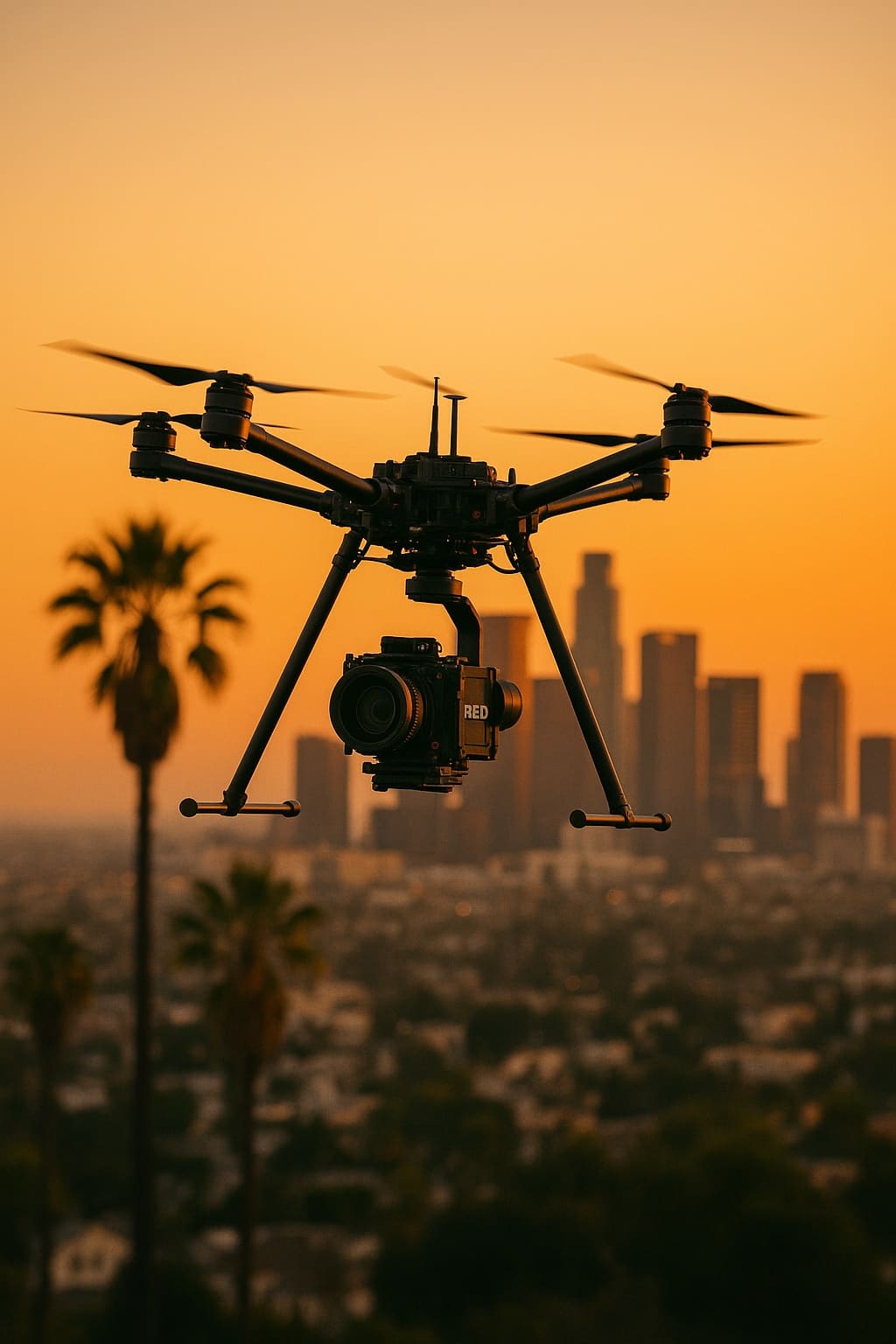
Los Angeles has more controlled airspace per square mile than almost any other U.S. film market. Five major airports sit inside a 25-mile radius of downtown, plus heliports, military overlays, and event-driven temporary restrictions. For producers staffing aerial in LA, this is not optional knowledge. The drone operator who actually knows the airspace will save you from the call sheet blowing up the morning of the shoot.
Here is what producers should understand about how LA airspace works, what LAANC authorization actually covers, and the airport-by-airport specifics that change how an aerial unit operates on the ground.
Why LA airspace is harder than other production markets
Los Angeles concentrates more controlled airspace than New York, Atlanta, or Toronto. The reason is structural. LAX is a Class B airport with an inverted-wedding-cake airspace footprint that extends roughly 30 nautical miles from the airport at high altitudes and 10 nautical miles at lower altitudes. Inside that footprint are four other airports: Bob Hope (BUR), Long Beach (LGB), Van Nuys (VNY), and Hawthorne (HHR), each with its own Class C or Class D airspace ring. Add Santa Monica (SMO), military reservations along the coast, and frequent temporary flight restrictions for VIP movements, and the result is an airspace map that is genuinely complicated. The LAX Class B veil also reaches up the coast into Malibu, so coastal days are planned the same way; our drone cinematography in Malibu page covers that corridor.
For commercial drone operations under FAA Part 107, that complexity translates directly into pre-production work. Every shoot location needs its airspace class identified before the drone goes up. Many locations require LAANC authorization. Some require manual coordination with the controlling facility. A few require waiting weeks for a special authorization.
What LAANC actually is
The Low Altitude Authorization and Notification Capability (LAANC) is the FAA system that grants drone operators near-instant authorization to fly in controlled airspace, up to specified altitudes published in the UAS Facility Maps for each airport.
The mechanics are simple. The pilot opens a LAANC-approved app, draws or selects the planned operating area, picks the altitude, and submits. For airspace cells where the authorized altitude limit allows the planned operation, approval is instant. For cells that require higher altitudes than the published limit, LAANC routes the request to the controlling facility for manual review, which can take days or weeks.
What LAANC covers: lawful authorization to operate in specific airspace bins at specific altitudes for specific time windows.
What LAANC does not cover: airport-specific operational restrictions, military airspace overlays, temporary flight restrictions, or any operation outside the published UAS Facility Map authorizations.
Airport-by-airport: how LA airspace shapes shoots
LAX (KLAX) — Class B. The most restrictive airspace in the region. UAS Facility Map authorizations near LAX are heavily restricted, with many cells limited to 0 feet AGL (no drone operations) and others capped at 50 to 100 feet. Shoots in West LA, Playa del Rey, El Segundo, and along the Westchester coastline are routinely affected. Locations directly under the LAX approach corridors or along the departure paths often require flight altitudes that LAANC will not auto-approve. We pull authorizations 7 to 14 days in advance for sensitive LAX-proximate shoots.
Bob Hope (KBUR) — Class C. Burbank Class C airspace covers the heart of the studios. Universal, Warner Bros, Disney, NBC Studios — many of the largest production lots in Los Angeles sit inside the BUR airspace ring. LAANC altitude authorizations vary by cell, with most cells allowing 100 to 200 feet AGL. For studio-lot or backlot shoots requiring higher altitudes, manual authorization from the controlling facility is the path.
Long Beach (KLGB) — Class D. Long Beach airspace is more permissive than LAX or BUR. Most of downtown Long Beach, the harbor, and the surrounding industrial areas allow LAANC authorizations to 300 to 400 feet. The cruise terminals, the Queen Mary, and the convention center sit inside the LGB ring. Aquatic and harbor-side shoots also need to account for the Marine Stadium area.
Van Nuys (KVNY) — Class D. Van Nuys is the busiest general aviation airport in the United States, which means heavy small-aircraft traffic and tighter coordination on day-of operations. The airspace itself is permissive at LAANC altitudes, but operators need to be tuned in to ATC chatter for nearby traffic. Shoots throughout the San Fernando Valley typically fall inside VNY airspace.
Santa Monica (KSMO) — Class D. Santa Monica is the most production-friendly of the LA airports for drone operations. The airspace is small and the LAANC authorizations are typically generous. Many of the Westside commercial shoots, the Santa Monica Pier, and the beach corridor sit inside or adjacent to SMO airspace. The airport is scheduled for closure in 2028, but the airspace classification has not yet changed. One thing LAANC does not cover on that coastline: the sand itself. Beach filming is a land-use permission handled by the county, which we covered in drone filming at Venice Beach under the LA County pilot program.
Hawthorne (KHHR) — Class D. Smaller and quieter than the others. Hawthorne is relevant for SpaceX-adjacent shoots and the South Bay industrial corridor.
When LAANC is not enough
Three production scenarios commonly require coordination beyond LAANC:
First, night operations in controlled airspace. The standard Part 107 night flight allowance (added in 2021) requires anti-collision lighting, which most cinema drones already have. But shoots that require flight beyond the standard night allowance need a Night Flight Waiver, which is operator-specific and not airport-specific.
Second, altitudes above LAANC ceiling. If the shot calls for higher than the authorized ceiling for a given airspace cell, the request goes to the controlling facility (e.g., LAX TRACON) for manual review. Lead time can range from 7 days to several weeks. For commercial shoots that need overhead helicopter-replacement altitudes, this is the path.
Third, temporary flight restrictions (TFRs). TFRs are issued for presidential movements, wildfire response, VIP security, major sporting events, and emergency air operations. A TFR can pop up the day of the shoot and ground the aerial unit instantly. There is no LAANC override. The drone has to stay on the ground until the TFR lifts. The aerial unit needs day-of monitoring to catch these in time. Our guide to drone TFRs in Los Angeles covers how productions schedule around them.
How we handle airspace on shoot day
Drone Tech Aerial’s airspace workflow for any LA shoot has three layers.
Pre-production (7 to 14 days out): The aerial unit pulls LAANC authorization for the specific locations and altitudes on the call sheet. If altitudes exceed the LAANC ceiling, we file the manual authorization request with the controlling facility on day one of pre-production, not the day before the shoot. We also identify any historical TFR patterns for the dates (presidential travel, major sporting events, fire-season risk).
Day before the shoot: Re-check the LAANC authorization is still active. Check the FAA NOTAM system for any TFRs issued in the previous 24 hours. Confirm crew radio frequencies and the emergency procedures with the 1st AD.
Shoot day: Verify TFR status one more time before the first launch. Maintain a live air-traffic monitor for nearby aircraft. Confirm direct radio coordination with the controlling facility if the shoot is inside Class B or C airspace.
None of this is optional for productions in LA airspace. It is the operational backbone that lets the aerial unit fly when the day arrives.
Three questions to ask before booking an aerial unit in LA
For producers vetting drone operators, three questions cut through quickly.
First, ask which airports’ airspace the operator regularly flies in. If the answer is vague or skips LAX and BUR, that is a flag. LAX and BUR are the two airports most likely to disrupt a production schedule, and an operator who avoids them is an operator who has not solved them.
Second, ask how the operator handles altitude requests above LAANC ceiling. If the answer is “we work around it,” that means the operator does not pull manual authorizations and is limited to LAANC-default altitudes. For shoots that need overhead establishing shots, that is a meaningful capability gap.
Third, ask how the operator monitors TFRs on shoot day. The answer should describe an active monitoring workflow that runs the morning of the shoot. If the answer is “we’ll check at some point,” the operator does not have the discipline to catch a TFR before the first launch.
How we operate
Drone Tech Aerial holds FAA Part 107 certification with active night flight waivers, operations-over-people compliance, and LAANC authorizations for all five LA-area airports including LAX Class B. FilmLA permitting and LAANC airspace authorization are handled in-house from pre-production through the shoot day. The aerial unit reports to the 1st AD on set comms with active TFR monitoring throughout the day.
The airspace is one layer of the stack. Every approval a Los Angeles drone shoot needs, airspace included, is on one page in our Los Angeles drone filming permit guide.
If you are staffing aerial for a Los Angeles production and want the airspace handled by someone who has solved it, see our Part 107 crew, our drone pilot Los Angeles service page, our drone videography in Los Angeles page for the LAANC and FilmLA workflow from the production side, our producer’s compliance checklist for the full regulatory framework, or request a quote for your specific show.