September 10, 2026 ·4 min read
By Jaron Denson, owner and aerial director of photography at Drone Tech Aerial. FAA Part 107 remote pilot, flying productions in Los Angeles since 2012.
Drone vs Helicopter for Aerial Filming: When Each Wins, and When You Want Both
Every aerial sequence eventually hits the same production question: drone or helicopter? The honest answer is that they are different tools occupying different altitude bands, speed ranges, and budget lines, and the productions that get the most from aerial work treat them as complements rather than competitors. We have spent years flying drones in shared airspace with film and broadcast helicopters, including race coverage where we deconflicted with eleven helicopter pilots on working radios, so this comparison comes from alongside the manned side, not from a distance.
The regulatory geometry
The airspace rules split the vertical world cleanly. Part 107 keeps drones at or below 400 feet AGL (or within 400 feet of a structure), while 14 CFR 91.119 keeps fixed-wing manned aircraft 1,000 feet over congested areas and 500 feet from people and property elsewhere, with helicopters allowed lower only when it creates no hazard, and film work below that running on FAA motion picture waivers with their own approval chain.
Read that as a design constraint: the band from ground level to 400 feet belongs to the drone, the band above 1,000 feet belongs to the helicopter, and the zone between is negotiated case by case. If the shot lives at window height, berm height, or talent height, it is a drone shot by law before it is one by preference. If it is a high, wide city tapestry at dusk, that is helicopter geography.
What each platform is physically better at
The helicopter’s advantages are endurance, speed, and stabilized long glass. A fuel load buys hours aloft against a drone battery’s minutes, cruise speeds run well past anything a cinema drone sustains, and a gyro-stabilized nose system carries long lenses with zoom ranges no drone gimbal package matches. Long linear chases, freeway pursuits, sustained orbits over a city, coastline runs measured in miles: the helicopter holds these effortlessly.
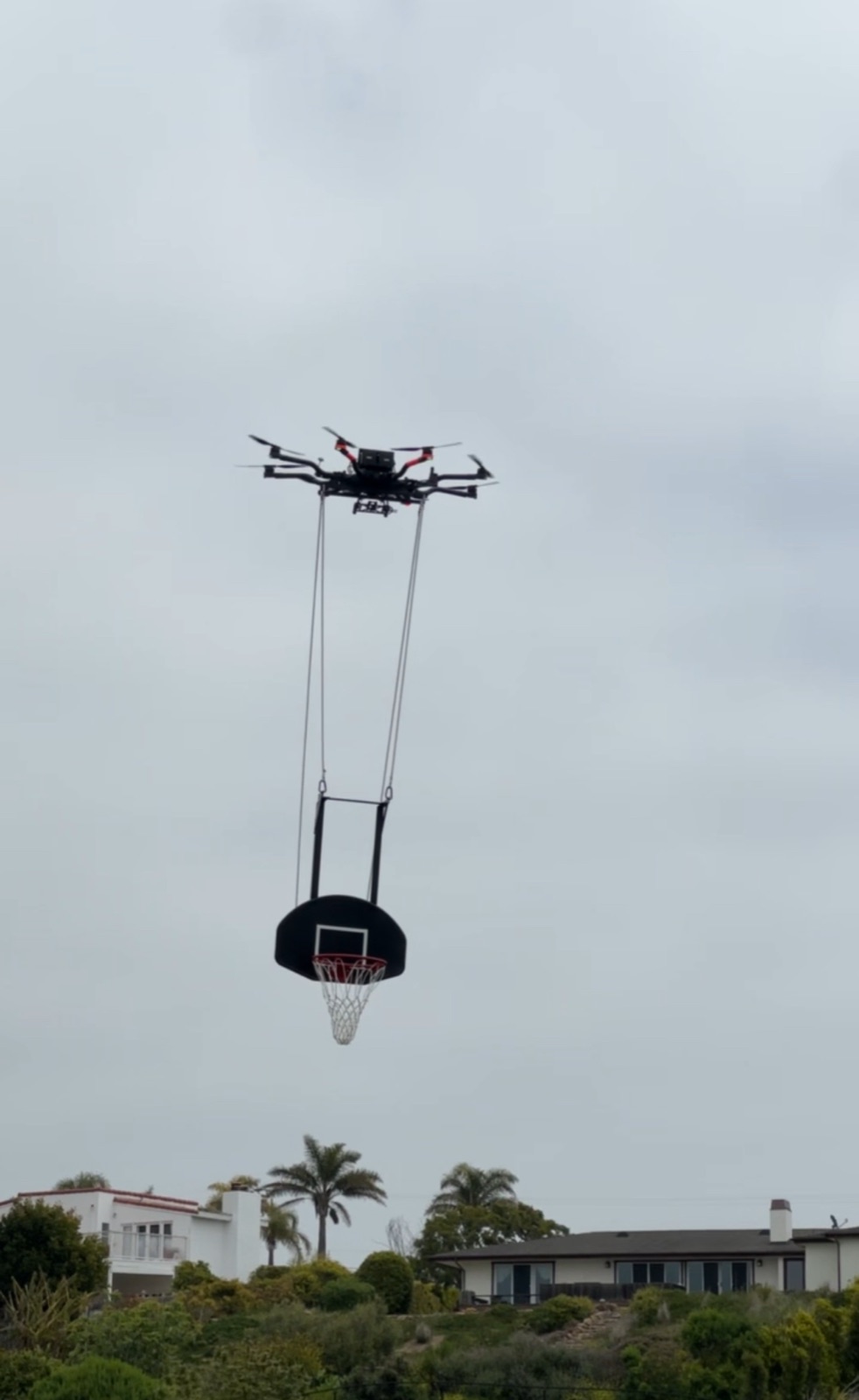
The drone’s advantages are proximity, precision, and repeatability. It flies where a helicopter cannot legally or physically go: under tree canopy, through structures, down an alley, feet from talent, inches over water. It repeats a programmed or rehearsed move identically across takes, which matters enormously for designed transitions and choreographed sequences. And it does this carrying real cinema cameras: our Freefly Alta 8 flies the production’s ARRI Alexa Mini or RED with full lens control, and the DJI Inspire 3’s full-frame Zenmuse X9 shoots 8K ProRes RAW. The platform details live on our gear page and in our heavy-lift guide.
The production footprint is a different species
A helicopter aerial day is an aviation operation attached to your shoot: aircraft positioning, fuel, a landing zone or airport staging, a mounted camera system with its technician, an aerial coordinator, and the scheduling gravity all of that brings. It delivers shots nothing else can, and it costs like the operation it is, typically a five-figure line item once the aircraft, camera system, and specialist crew are on it.
A drone unit arrives in cases. Two or three crew, no fuel truck, no landing zone, setups measured in minutes, and the ability to move with the company across multiple locations in a day. The line item is a fraction of the helicopter’s, and the cost mechanics that actually drive a drone bid, crew configuration, platform, and compliance scope, are what each quote is built on.
That difference changes how directors use aerials. When the aerial camera is cheap to deploy and fast to reset, it stops being a once-per-film event and becomes a tool used across the schedule.
When you want both
Big sequences frequently split naturally: helicopter for the high energy master and the long chase, drone for the low connective tissue and the moments near talent. We have worked exactly this hybrid on broadcast motorsports, where helicopters held the desert-scale coverage while we worked 5 to 30 feet off the racing line. The coordination between manned and unmanned aviation is a discipline of its own, and it is one an aerial unit should bring to your production rather than learn on it: shared frequencies, altitude blocks, and handoffs agreed before the first aircraft lifts.
Deciding for your sequence
The short version for a producer boarding an aerial sequence:
- Altitude under 400 feet, proximity to talent or structures, repeatable designed moves, tight locations, multi-location days: drone.
- Sustained speed, long linear distance, high wide masters, long-lens stabilized work from altitude: helicopter.
- A marquee sequence with both registers: both, coordinated properly.
For the full picture of what a drone unit brings to a Los Angeles production, from platforms through compliance, see our drone videography services in Los Angeles. If you are weighing the aerial approach for a specific sequence, book a consultation: we will tell you honestly which tool the shot wants, including when the answer is a helicopter.